I was listening to some early videos by Journey In World-Building, talking about choosing a genre. Setting a genre seems like a good way to reach one's niche and be true to your own interests. This video was a timely discovery for me (and I love finding other fellow Aussies doing similar niche things!) because I've been trying to articulate what my genre is. And I must say it's been pretty difficult – Mostly because I had pretty thoughtless preconceptions of what certain labels might flag, but after some reading and a bit of thinking, I think I've settled on one for now:
One of the recurring questions I come back to time and time again is 📚 How can stories be told in mixed media ways? I've always loved “choose your own adventure” books, and naratively driven video games. Something about the branching alternatives is more involved than straight prose (or a linear TV show/movie for that matter), and I like that sense of exploration and agency.
I've only dabbled in table top role playing games (TTRPGs) and board games (I like going at my own pace), but have always been curious about D&D and other such games where you create the world you have your narrative experience in. Recently I learnt about solo rpgs, which are broadly TTRPGs but for solo players. This has really quipped my interest – it might let me explore a narrative with agency, in a non-screen tactile form?
Currently building a website to be my long-term digital home, but once this is done I might write up a deep-dive into solo RPGs to see what these are about.
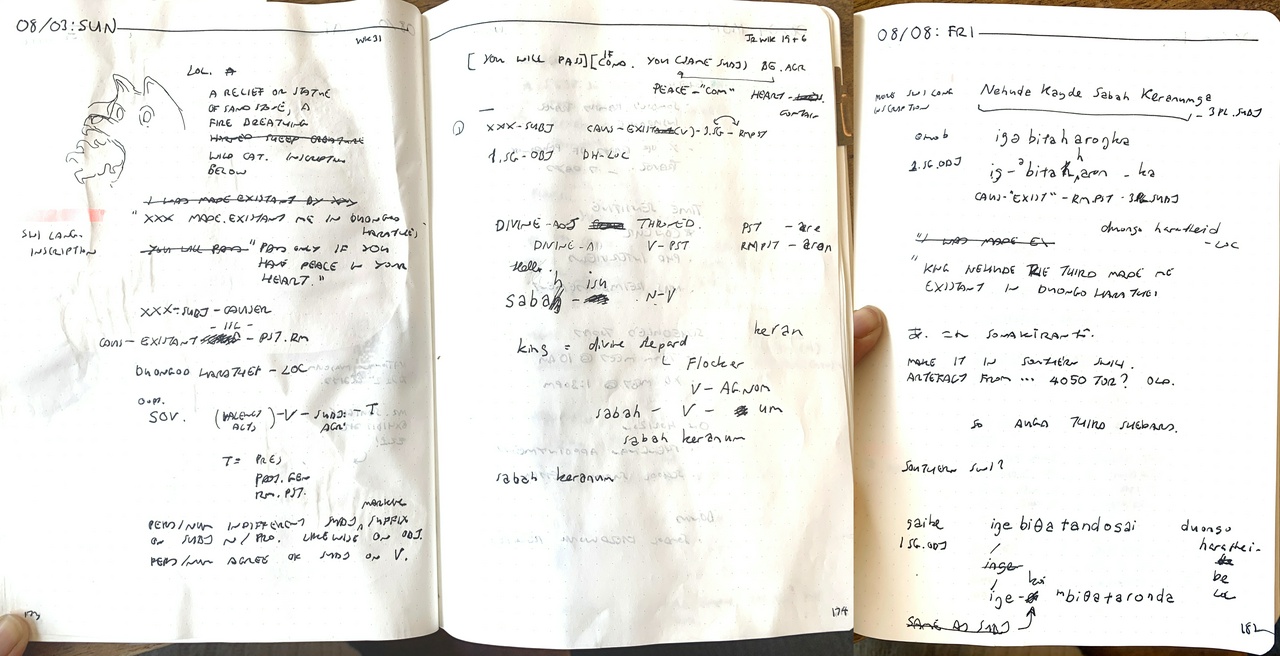
To StoryLang (verb)/StoryLanging (gerund): to create selective parts of a fictitious language for the purposes of adding flavour to a fictitious world. Contrast with ConLanging (to create a cohesive fictitious language for the enjoyment of doing so. Often has an emphasis on phonology and morpho-syntax of the fictitious language.)
In a past life I did some documentary linguistics in a remote part of the world. These photos of StoryLanging a fictitious language bring back memories.
A quick scan of world builders shows, I think, on the one hand the highly detailed world builders who get great creative joy in sticking to scientific guidelines, and on the other, the creators who love to be totally free of the realism of our world with strong fantastical elements. I think most people fall somewhere in between, and there’s this tension between wanting to have some realism so you don’t break immersion, but you also want to follow your “what if” question that guides your building.
My answer to the question of “how realistic should a world be?” is “it depends on your goal.” I’ve taken a very leisurely approach to my world building in the sense that I’ve spent a reasonable amount of time experimenting with “enough earth realism” to build a continent that will, hopefully, let me explore how “nature” affects human cultures and societies (one of my world building Feynman questions).
In other words, I want to build a world, but I don’t want full control over it’s form. My earliest attempts of world building were very much working off cultural archetypes in our world without too much thought of geography, but they felt too much like their source inspiration – in which case I may as well just do some historical setting drama, but that’s not what I wanted either. I wanted the world to emerge, and for some surprises to work its way in which I haven’t anticipated. So my solution was to “build an apple pie from scratch”, as the legendary world builder World Building Pasta calls his blog.
This log isn’t a “how to” but a log of the scrappy process I took, and to see whether I’ll fulfil my goal in the long run. I fly by a lot of the detailed process of the steps, because there are already excellent videos that I followed by Artifexian and Madeline James. If anything, this log will be a curiosity for non-world builders, and maybe even an inspiration to other world builders that scrappy and cherry-picky scientific world building is fine depending on your goals.
I've been thinking a lot about why I, or anyone for that matter, builds fictitious worlds. Often times people seem to world build for particular projects, such as creating a narratively consistent setting for a story or a game. I began that way, with the desire to create a setting for a series of story ideas I had. But over the years the story has fallen second place to the world building itself, and I’ve often wondered what it is about world building that is so compelling to myself, and as it turns out, to a large number of others.
There is definitely an element of a power fantasy to world building. Playing god, and it’s a wonderful form of escape where you focus on the details and do the creation. I lean towards the human cultures, history and geography side of world building, rather than the space or magic side of things. I get a lot of my fun from having some constraints in place. In my case that’s the constraint of geography, and, for a lack of a better word, humanity.